Why Doesn’t Traditional SaaS Pricing Work for AI?
Per-seat pricing makes sense when software helps a person do their job.
If 100 people use a CRM, the company pays for 100 seats. The software company earns more as the customer adds employees.
AI agents break that connection.
Imagine a company introduces an AI support agent and reduces its support team from 100 people to 50. The software is now doing more of the work and creating more value—but a per-seat model could leave the vendor earning less.
That is the central problem.
AI allows customers to complete more work with fewer people, while traditional SaaS pricing depends on the number of people using the product.
Software companies therefore need a different way to measure value. But there is no obvious replacement.
How Is Salesforce Pricing AI?
Salesforce shows how complicated AI pricing can become.
The company currently offers several ways to buy Agentforce. Customers can pay for usage, purchase Flex Credits, buy employee licences, choose unmetered add-ons or pay for completed customer-service resolutions.
Its current pricing page lists a $125 per-user monthly add-on with unmetered employee usage. Agentforce 1 Editions begin at $550 per user per month and include 2.5 million Flex Credits per organisation each year. Salesforce also offers a $5 monthly Agentforce user licence, although customers still need Flex Credits. Salesforce Agentforce pricing
Then there is its newer outcome-based model.
Salesforce’s Agentforce Help Agent, made generally available in July 2026, costs $2 for each customer issue it resolves. The company says it does not charge when a customer requests a human or leaves negative feedback.
Salesforce tested the agent on its own support site before launching it. According to the company, Agentforce handled 4.3 million enquiries and resolved 70% of them. Salesforce’s Help Agent announcement
That sounds refreshingly simple: pay when the AI works.
But even the word “resolved” needs a detailed definition.
Salesforce says a billable resolution must involve at least two conversational turns, receive no explicitly negative feedback and finish without the customer escalating to a person. If an interaction lasts longer than two hours, it can count as a second resolution. Salesforce’s resolution rules
That is the problem with outcome-based pricing. The headline is simple, but the rules behind it rarely are.
How Is OpenAI Pricing AI Work?
OpenAI is using a mixture of subscriptions, credits, messages and token-based usage.
Its current Business and Enterprise rate card gives different credit costs to different activities. Agent mode uses approximately 30 credits per message, deep research uses 50 credits per task, image generation uses five credits, and voice uses five credits per minute.
Some workplace tasks are priced according to the tokens they consume rather than a fixed number of credits. OpenAI estimates that a typical ChatGPT for Excel or Sheets task may consume between five and 20 credits, while a PowerPoint task may consume between 10 and 50 credits.
The final amount depends on the model, input size, task complexity and length of the output. OpenAI’s Business and Enterprise rate card
This approach reflects a basic truth about AI: two tasks that look similar to a user may have very different costs behind the scenes.
One request might require a short answer. Another may need a large amount of data, several tools and a long reasoning process.
Charging the same price for both can hurt the software company’s margins. Charging by tokens protects the vendor, but makes the customer’s bill harder to predict.
How Is Perplexity Pricing Enterprise AI?
Perplexity combines seats with monthly credits.
Enterprise Pro users receive 500 credits per month, while Enterprise Max users receive 15,000 credits. Those credits power more computing-heavy features, including Perplexity’s Computer agent.
The number of credits a task consumes depends on its complexity and the resources required to complete it.
Unused credits do not roll over. They expire at the end of the billing cycle. Perplexity also states that its credit prices, task ranges and included allowances may change.
If users run out, active tasks can pause and new credit-consuming tasks can be blocked until more credits become available. Perplexity’s enterprise credit guide
Credit systems give companies flexibility. They allow several AI features to share one billing unit.
But credits also hide the real-world price.
Most buyers understand what £20 or $20 means. “Five hundred credits” means very little until they know how many tasks those credits will complete.
What Is Anthropic Doing Differently?
Anthropic’s latest move focuses on helping enterprise customers understand and control usage.
In July, Anthropic introduced additional analytics showing Claude Enterprise customers their usage, cost per team, cost per model and progress against spending limits.
Administrators can also choose which Claude models are available to different employees. That means routine work does not have to use the most expensive model by default.
For Claude Code, Anthropic now estimates measures such as cost per commit, productivity improvements and annual value. It also provides an API so finance teams can bring Claude spending data into their existing cost-management systems. Anthropic’s enterprise cost controls
These controls point to a larger issue.
Once AI is charged according to usage, customers need a way to understand that usage in real time. A bill arriving at the end of the month is no longer enough.
Pricing, analytics and spending controls are becoming part of the same product.
Why Is Usage-Based AI Pricing So Unpredictable?
Traditional SaaS has high development costs but relatively low costs for each additional user.
AI is different. Every prompt, generated image, research task or agent action can create a new cost for the vendor.
Those costs also vary.
A simple question might require very little computing power. An AI agent completing a multi-step task might search several systems, process thousands of tokens, call external tools and try an action more than once.
The software company does not always know how much the customer will use. The customer does not always know how much each task will consume.
Usage pricing solves part of the vendor’s problem by passing variable costs to the buyer. But it gives the buyer a new problem: an unpredictable bill.
That helps explain why 61% of leaders in the recent DigitalRoute study said forecasting AI usage and revenue has become harder.
Is Outcome-Based AI Pricing the Answer?
Outcome pricing is attractive because it connects the bill to something the customer cares about.
Instead of paying for tokens or actions, a customer might pay for:
- A support issue resolved
- A qualified sales lead
- A completed report
- An invoice processed
- A successful appointment booking
The customer does not need to understand what happened behind the scenes. They only pay for the result.
But this works only when the outcome is clear and measurable.
Customer support is relatively easy because there is a recognisable finish line. Either the AI answered the question or it passed the customer to a human.
Other types of work are harder.
What is a completed marketing campaign? What is a successful piece of research? If AI contributes to a sale alongside several employees and tools, which system deserves credit?
Outcome pricing often leads to a new argument: who caused the result?
It can also make revenue unpredictable for the vendor. If customers have a quiet month, complete fewer tasks or experience lower demand, the software company earns less—even though its own costs continue.
Are Software Companies Really Changing Their Prices Constantly?
There is an important distinction between changing the number and changing the model.
A recent analysis tracked 855 pricing-page events across 276 SaaS tools during the second quarter of 2026. After checking the changes manually, researchers found that only six of 146 comparable tools had genuinely changed their list prices.
In fact, 96% held their list prices steady.
Most of the activity involved renamed packages, combined tiers, new billing structures and retired plans. SaaS Price Pulse’s Q2 2026 analysis
This means software companies may not always be increasing the visible price. Instead, they are changing what the price includes and how extra usage is calculated.
That can be just as important.
A product can keep the same £20 headline price while removing included usage, introducing credits or charging separately for its most valuable AI features.
The sticker stays the same. The real cost changes.
What Would Better AI Pricing Look Like?
There may never be one AI pricing model that works for every product.
Customer-service agents may suit outcome-based pricing. AI platforms may need usage pricing because their customers build many different things. Workplace tools may work best with a subscription that includes a reasonable amount of usage.
But good AI pricing should still follow a few basic rules.
First, customers should understand what they are buying. If the company uses credits, it should show how many typical tasks those credits will cover.
Second, bills should be reasonably predictable. Usage alerts, spending limits and clear examples should be part of the product.
Third, outcomes need firm definitions. If a customer pays for a resolution, lead or completed task, both sides should know exactly what qualifies.
Finally, companies should explain the difficult details themselves. Credits that expire, tasks that consume variable amounts and usage that does not roll over should never be hidden in the small print.
So, Why Is AI So Hard to Price?
AI is hard to price because its cost, usage and value can all change from one task to the next.
Per-seat pricing is predictable, but it does not reflect work completed by autonomous agents. Usage pricing reflects the vendor’s costs, but creates uncertainty for customers. Credit systems are flexible, but can hide the actual price. Outcome pricing feels fair, but only works when success is easy to define and prove.
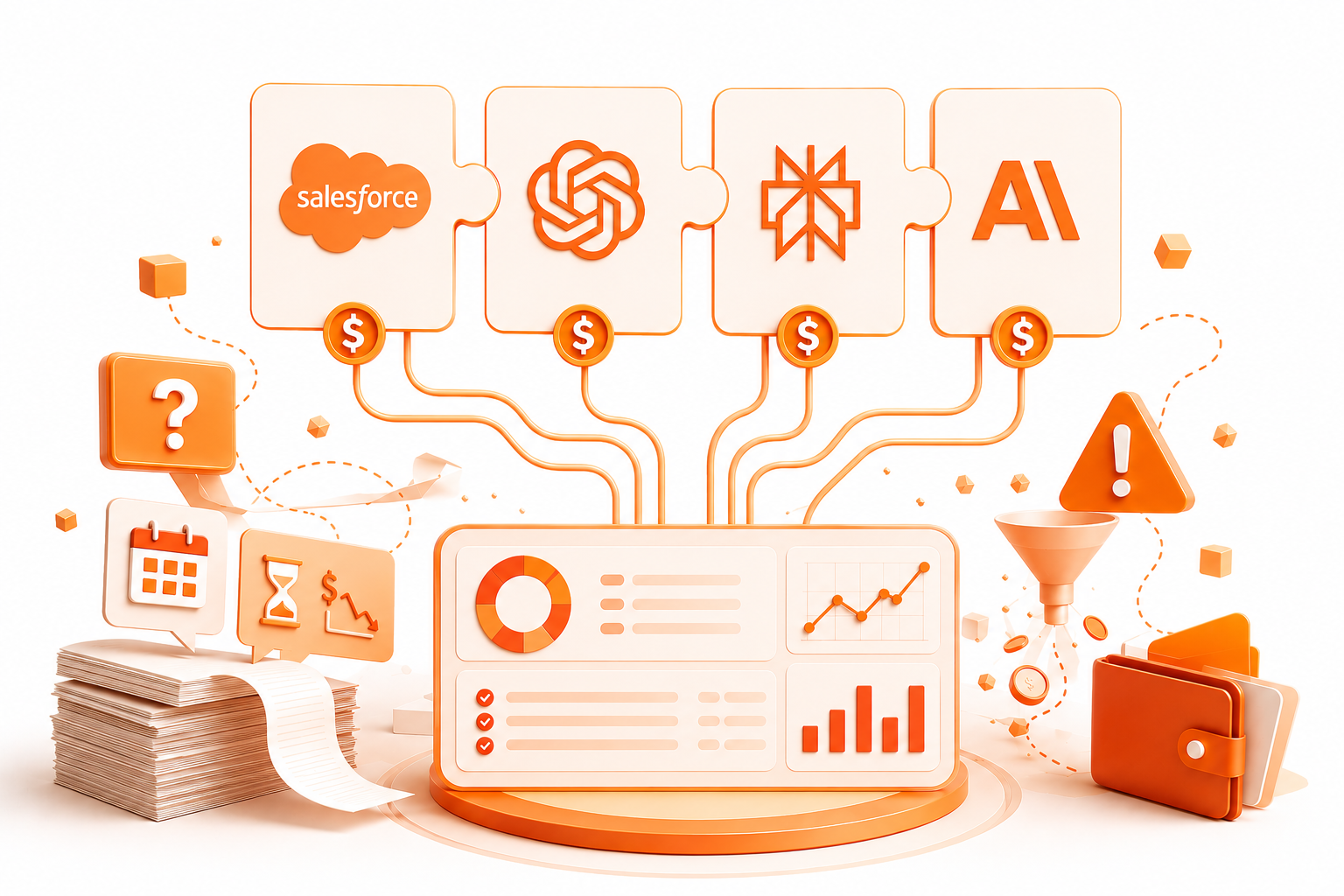
Salesforce is charging for seats, credits, usage and resolutions. OpenAI combines subscriptions, credits and tokens. Perplexity gives enterprise users monthly credits that expire. Anthropic is building more controls to help customers understand what their usage costs.
They are not simply choosing different prices. They are choosing different definitions of value.
Until the industry agrees on what AI customers are really buying—access, intelligence, activity or results—AI pricing will continue to feel like an experiment conducted in public.